

 The Iceberg Beneath Your Systems Portfolio: A Field Guide to the Technical Debt No One Budgets For
When most leaders hear “technical debt,” they picture messy code. A tangle of shortcuts a developer promised to clean up later. That picture isn’t wrong. It’s just dangerously incomplete.
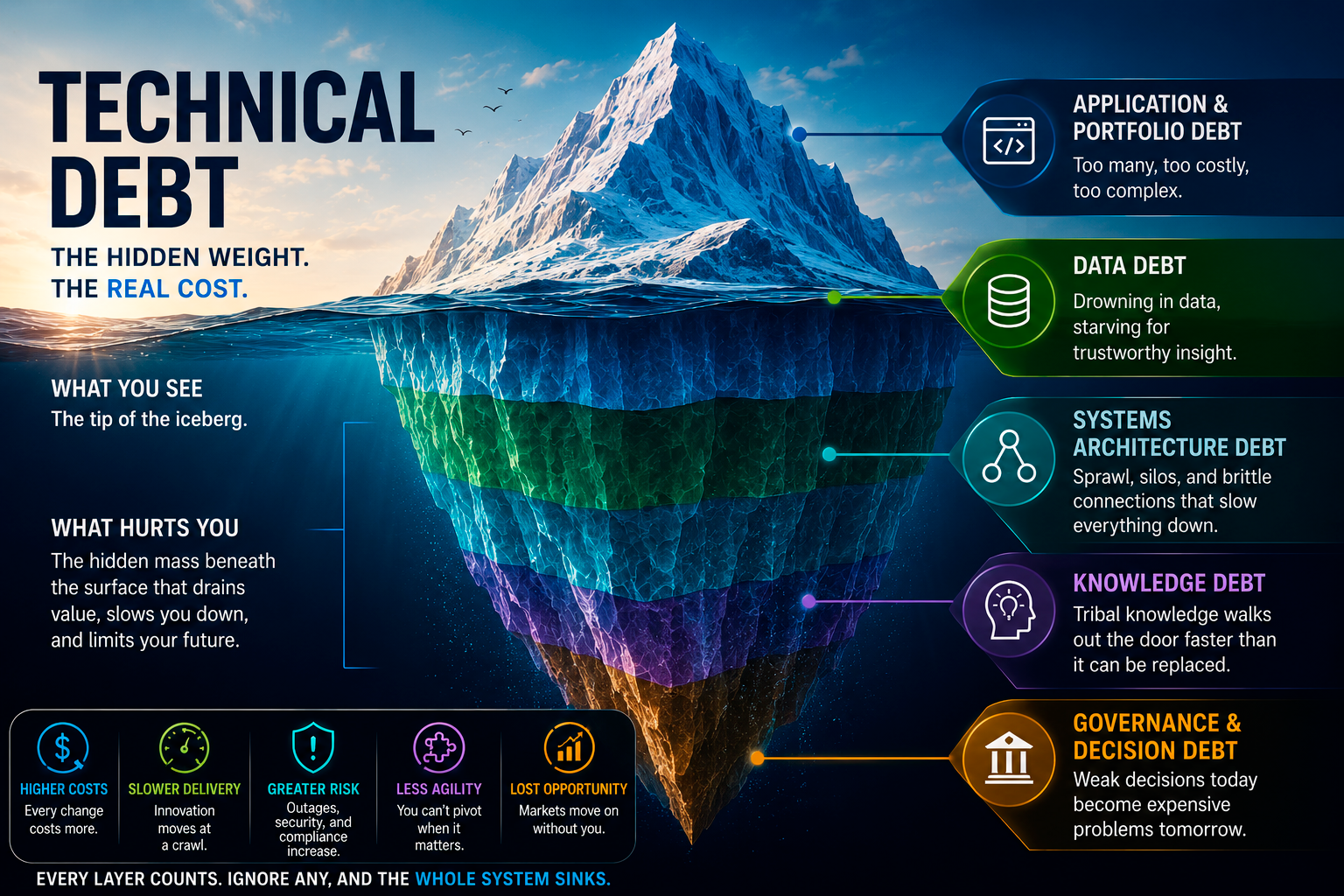
The code you can see is the tip of the iceberg. It’s real, it’s costly, and it’s the smallest part of the problem. The mass that sinks ships sits below the waterline: the way systems connect, the way data flows (or doesn’t), and the institutional knowledge that walks out the door every time someone retires. Gartner projects that architectural technical debt will account for roughly 80% of all technical debt by 2027, and the market for technical debt management tools to address it is on track to hit $1.2 billion by end of 2026. The AI coding assistants helping teams clean up code-level debt are making this worse, not better; they generate more code, faster, on top of foundations that were never designed to hold it.
The iceberg has five layers. Three are assets you own: your applications, your data, and the architecture connecting them. And two that are organizational: the knowledge your people carry, and the governance that decides what happens to all of it.
- Applications — your portfolio of systems, many too costly and complex to change
- Data — redundant, decaying, ungoverned, and unreliable at scale
- Architecture — the connective layer, full of point-to-point sprawl and undocumented dependencies
- Knowledge — the institutional context that lives in people’s heads and walks out the door
- Governance — or the absence of it, the root cause that lets all the others compound
Application and Portfolio Debt: Too Many Systems, Too Much Complexity
Most enterprise portfolios carry more applications than anyone can justify, and changing any of them costs more than it should. Here’s why:
- Poor code quality. High complexity, duplicated logic, and inconsistent standards make every future change more expensive than the last. Think of a house where no two rooms were wired the same way. Each new outlet requires reverse-engineering what the last contractor did.
- Legacy systems with no one left to maintain them. Legacy languages are not inherently the problem. The problem is when the handful of people who understand them are nearing retirement. The application becomes a locked room with no key. You cannot safely change what no one fully understands, so the system petrifies. The debt here is the vanishing human context around the code, not the code itself.
- Insufficient test coverage. Without automated tests, every change is a gamble. Teams develop a rational fear of touching working systems, so improvements stop and the portfolio freezes in place. A codebase you are afraid to modify is a codebase accruing interest.
- Security and dependency debt. Hard-coded credentials, unpatched libraries, and end-of-life frameworks are deferred liabilities. Each unpatched dependency is a loan against your future incident response budget, and the interest rate spikes the day a vulnerability goes public.
- Application redundancy. Three systems that do roughly the same thing means triple the licensing, triple the maintenance, triple the integration surface, and three conflicting answers to the same question.
- Lift-and-shift cloud migrations. Rehosting a monolith to the cloud without refactoring relocates the problem and adds a premium. You are paying elastic-cloud prices to run rigid, on-premises-era architecture, and wondering why the cloud bill went up while agility didn’t.
Data Debt: Drowning in Data While Starving for Trustworthy Insight
Most organizations we work with aren’t short on data. They’re short on data they can trust. That distinction matters more every year, and it matters most when you’re trying to do anything with AI:
- Redundant and orphaned data. The same records get copied again and again across structured, semi-structured, and unstructured stores until no one owns or remembers the originals. You keep paying to store all of it precisely because you can no longer tell what is inside.
- No master data management. Without MDM, every application keeps its own version of “customer,” “product,” or “patient.” Reconciling them becomes a permanent tax, analytics cannot be trusted, and AI has nothing reliable to learn from. When five systems disagree about a basic fact, the organization has no single source of truth. Only five competing rumors.
- ROT and dark data. Industry studies put roughly 85% of stored enterprise data in the redundant, obsolete, or trivial category, much of it never classified and never monitored. You are paying to store, secure, and back up a vast volume of content that delivers no value while widening compliance exposure.
- Decaying data quality. Data does not sit still. Contact data alone decays an estimated 25 to 30 percent per year. By many measures, only about 30% of enterprise data is reliably high-quality. Feed that into analytics or AI and the rule is unforgiving: garbage in, garbage out, now at machine speed.
Architectural Debt: The Connective Layer No One Mapped
Architectural debt is quiet until it isn’t. By the time it surfaces as a crisis, it’s been compounding for years.
- No shared systems or data architecture. When there is no blueprint, every team optimizes locally and the whole becomes incoherent. It is a city with no zoning code. Each building is fine on its own, but there are no roads between them and the plumbing connects in ways no one can map.
- Point-to-point integration sprawl. When systems share data through bespoke, custom interfaces rather than governed standards, you build spaghetti. Change one system and you risk breaking five others downstream. The solution is hub-and-spoke architecture: route master data through a governed hub rather than hand-wiring every system to every other. At enterprise scale, a federated, multi-hub model manages domain-specific data through its own governed hub. What changes with scale is the number of hubs, not the governance principles.
- Architectural drift. Even well-designed systems erode. Over years of expedient changes, the real architecture diverges from the intended one until the gap causes systemic failures and soaring maintenance costs. Gartner describes this trajectory as heading toward a “breaking point,” and the danger is precisely that it is invisible until it isn’t.
Knowledge Debt: The Debt No Code Audit Catches
No code audit will catch this one. It doesn’t live in your systems, it lives in people, and people leave.
- Key-person risk. When critical system knowledge lives in one or two people’s heads, you’re at high risk for a continuity crisis.
- Documentation debt. Undocumented business logic slows onboarding, multiplies the risk of every change, and forces expensive archaeology before any modernization can begin. The system works, but only because a few people remember why.
- No source of truth. Most organizations have no mechanism that compels specialists to converge on a single best practice and record it as the standard. Knowledge stays scattered across individuals, each correct in isolation and inconsistent in aggregate.
- Shadow IT. Applications that governance doesn’t know about cannot be secured, maintained, or rationalized. You cannot manage, or retire, what you cannot see.
Governance Debt: The Root Cause Everything Floats On
Most organizations treat governance as the cleanup activity that follows the real work. That’s backwards. Without a framework for deciding what to invest in, modernize, or retire, no one owns those decisions. And when no one owns them, drift becomes the strategy.
Remediation without governance is a temporary fix. You clean it up; it grows back. The “new way” has to become the only way, and how things are done now.
Why Technical Debt Blocks AI Adoption
Here’s the conversation we keep having: a leadership team is excited about AI. They’ve seen the demos. They have a use case. They start building and then they hit the wall. Not a model problem. Not a vendor problem. A foundation problem. Fragmented data, undocumented systems, tangled dependencies. The portfolio can’t feed the model. The technical debt that was tolerable in a pre-AI world becomes the binding constraint on the most important capability of the next decade.
AI requires three things the debt actively undermines:
- Clean, governed data to learn from and reason about
- Documented, well-structured architecture it can navigate
- Code quality and dependency visibility that allows safe, fast iteration
There’s a sharper edge to this too. As teams point AI coding agents at messy portfolios, those agents generate more code on top of weak foundations accelerating architectural drift faster than any human team ever could. Without visibility into structure and dependencies, AI doesn’t pay down debt. It scales it.
The upside is real, though. Paying the debt down compounds in your favor. Knowledge captured and curated into a source of truth becomes governed data. Governed data consolidates into a master-data hub. That hub is what grounds AI in facts the business trusts. The same hub-and-spoke architecture that fixes integration sprawl is the foundation that makes AI reliable. Remediation stops being pure cost. It becomes the infrastructure for the capability everyone is racing toward.
What Technical Debt Actually Costs: The Financial and Operational Drain
There are two places this shows up on the books. One is financial, one is operational. Both are real, and both get worse the longer you wait.
The Financial Drain
- Most IT budgets are consumed “keeping the lights on,” leaving little for innovation
- Redundant applications multiply licensing and infrastructure spend
- Un-refactored cloud workloads inflate monthly bills without delivering agility
- Security debt converts into breach response costs the moment it is exploited
- Architectural debt is far cheaper to fix early than late; every deferred decision raises the eventual price
- Gartner sizes the market for technical debt management tools at roughly $1.2 billion by end of 2026
The Operational Drain
- Delivery slows as every change ripples unpredictably through brittle, tightly coupled systems
- Outages trace back to dependencies no one fully mapped
- Talented engineers burn out fighting legacy instead of building; morale and retention erode
- Continuity hangs on a few irreplaceable people
- Leaders cannot make confident decisions without portfolio visibility
- The organization cannot adopt technologies its competitors are using to pull ahead
None of this usually announces itself. There’s no single day when the alarm goes off. The organization just gets slower, a little more expensive to run, a little more fragile until someone looks up and realizes that “keeping the lights on” has become the entire IT strategy.
How to Start: Seeing the Whole Iceberg
The first move is not a rewrite or a migration. It’s getting an honest picture of what you actually have: the code above the waterline and the architecture, data, and dependencies below it. You can’t rationalize what you can’t see.
With that picture in hand, every system becomes a decision, not a mystery. The 5 R’s of application rationalization give you the framework:
- Refactor — improve in place
- Rehost — move to the cloud without redesign
- Rebuild — replace with a modern equivalent
- Retire — eliminate entirely
Organizations that skip the visibility step and go straight to action waste the modernization budget. The work feels productive; the portfolio doesn’t change.
Application Rationalization 360°: McLean Forrester’s Approach
We built Application Rationalization 360° to solve exactly this, and we built it to work in weeks, not quarters. As a strategic partner of CAST, named a Leader in the first-ever Gartner Magic Quadrant for Technical Debt Management Tools, we bring two tools to every engagement that together turn a fog of legacy systems into a navigable map.
CAST Highlight — Portfolio-Wide Scan
- Rapid scan across all applications in the portfolio
- Scores each application for cloud readiness, software health, security risk, and open-source exposure
- New capabilities score applications for Agentic AI readiness
- Shows where to act and, just as valuably, where not to waste effort
CAST Imaging — Deep Architectural Visibility
- Reverse-engineers individual systems, dependencies, data paths, and call flows
- Turns undocumented complexity into a navigable map
- Converts a fog of legacy systems into a prioritized, evidence-based modernization roadmap
Together, they produce a prioritized modernization playbook, not a slide deck full of recommendations, but an evidence-based decision framework tied to your actual systems. For organizations in the Federal space, Application Rationalization 360° is available as a Tradewinds-awardable offering.
The Bottom Line on Technical Debt
Technical debt isn’t a technology problem. It’s a business strategy problem. Every quarter of inaction raises the remediation cost, narrows the AI opportunity, and widens the gap between what your organization can do and what your competitors are already doing.
The debt is on your books whether you’re managing it or not. The only real choice is whether you do it deliberately or keep paying the interest without knowing how much you owe.
If mapping the hidden half of your portfolio is on your agenda, let’s talk.


